> Deep dive into the admin web portal. Back: [README](../README.md).
### Admin web portal
`GET /admin/` serves a management portal from the running router on the same
loopback-only bind as the API. It has no auth layer yet, so like the other
endpoints it is reachable only from `127.0.0.1`.
The portal is a **six-page, glass dark-mode** dashboard built on Tabler/Bootstrap
with a few lighter inline SVG icons (see `plans/admin-design-standards.md`
for the visual language and `plans/admin-work-framework.md` for the method
used to evolve it). The six pages are Dashboard, Models, Profiles, Decisions,
Controls, and Providers. It is implemented in `admin.py`, with
`config/admin_schema.sql` for its future tables and `admin/frontend/` for the
browser UI.
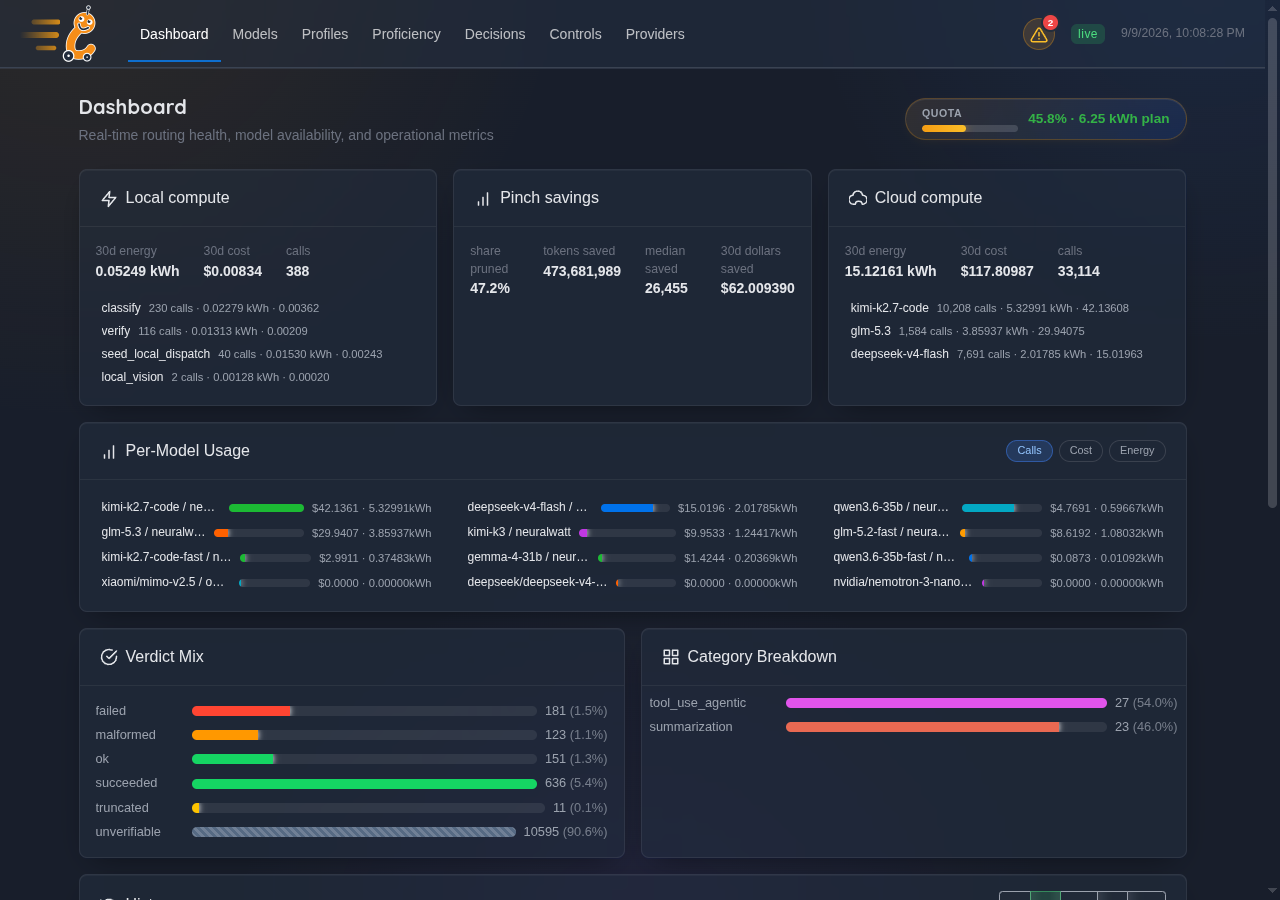
**Dashboard** — `GET /admin/` aggregates the router at a glance: a quota chip
(burn against `objective.plan_kwh_per_period`), per-model usage bars, verdict
mix and category breakdown, five history mini-charts, and a recent-decisions
table. Clicking the chip opens a detail modal with per-provider balances and
runway; each line is labeled by its billing shape, so `"telemetry"` balances
read as "overage allowance" and `"polled"` balances read as "credits". Tiny
values keep their sign: a negative balance smaller than half a cent renders as
`~$0.00 (slight overage)`, a positive tiny balance renders as `<$0.01`, and an
exact zero balance renders as `$0.00`.
**Pinch savings** — the dashboard card shows pinch's effect: share pruned (as a
percent), tokens saved, median saved, and 30d dollars saved. When pinch is
disabled the card shows "Pinch is disabled". The TUI dashboard has the same
pinch rows (`share_pruned`, `total_tokens_saved`, `median_tokens_saved`,
`dollars_saved_usd_30d`) pulled from the snapshot. See [docs/pinch.md](pinch.md)
for the full model.
**Loops** — the dashboard carries a Loops card (`admin/frontend/index.html#loops`)
showing the watchdog's open alerts, one row per alert. It pulls from
`GET /admin/api/watchdog/loops` (`watchdog_alerts` rows where `resolved_at` is
null) via `loadLoops()`. Each row shows exactly three things: a severity badge
(`critical` / `warning` / else `info`), the raw dedup key
(`opencode-loop:`), and `opened_at`. That is all the panel
shows today — it does **not** show the agent, model, top repeated target, calls,
or $ since the last landed change; those live in `watchdog_verdicts` and have
not shipped to this panel yet.
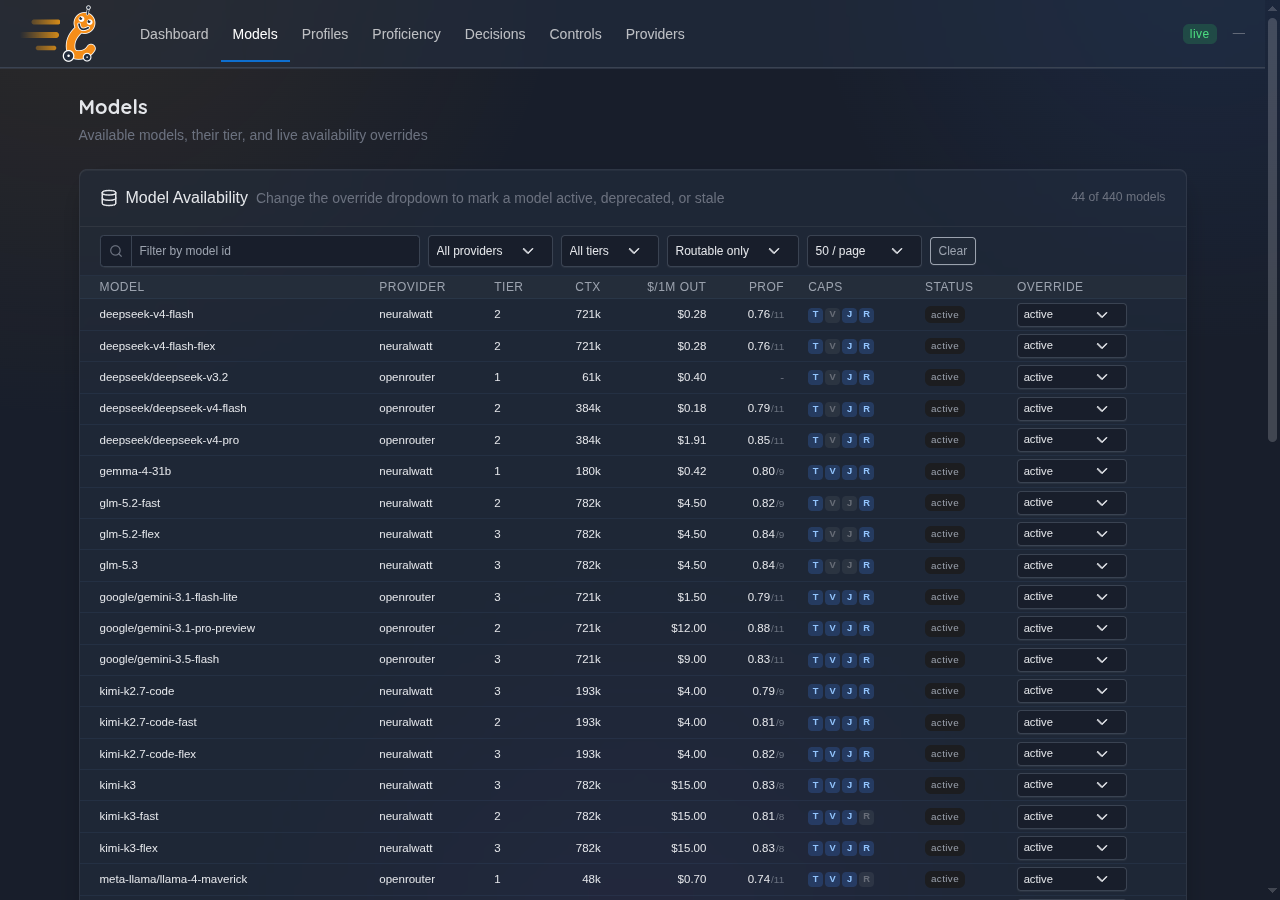
**Models** — `GET /admin/models` is the model-availability table. Each row shows
the serving class, tier, status, and an override dropdown (`active` /
`blocked` / `deprecated` / `stale`) that writes through to the routing hard
filters. By default the table hides deprecated and stale rows; enable the
**Show deprecated / stale** toggle to include them.
`blocked` is a fourth value in that same per-model override dropdown, distinct
from the catalog meaning of `deprecated`. It is an operator stop: a model an
operator has switched off, not one the catalog flagged. Routing and pinned
requests both exclude a blocked model (`_admin_excluded_models` in
`dispatcher.py` and `metrics.py`). Undo is setting the dropdown back to
`active` (clearing the override via `DELETE` on the availability path), not a
separate unlock — there is no per-model Block button beside evidence and no
Blocked list with reasons; those belong to the "not built yet" item below.
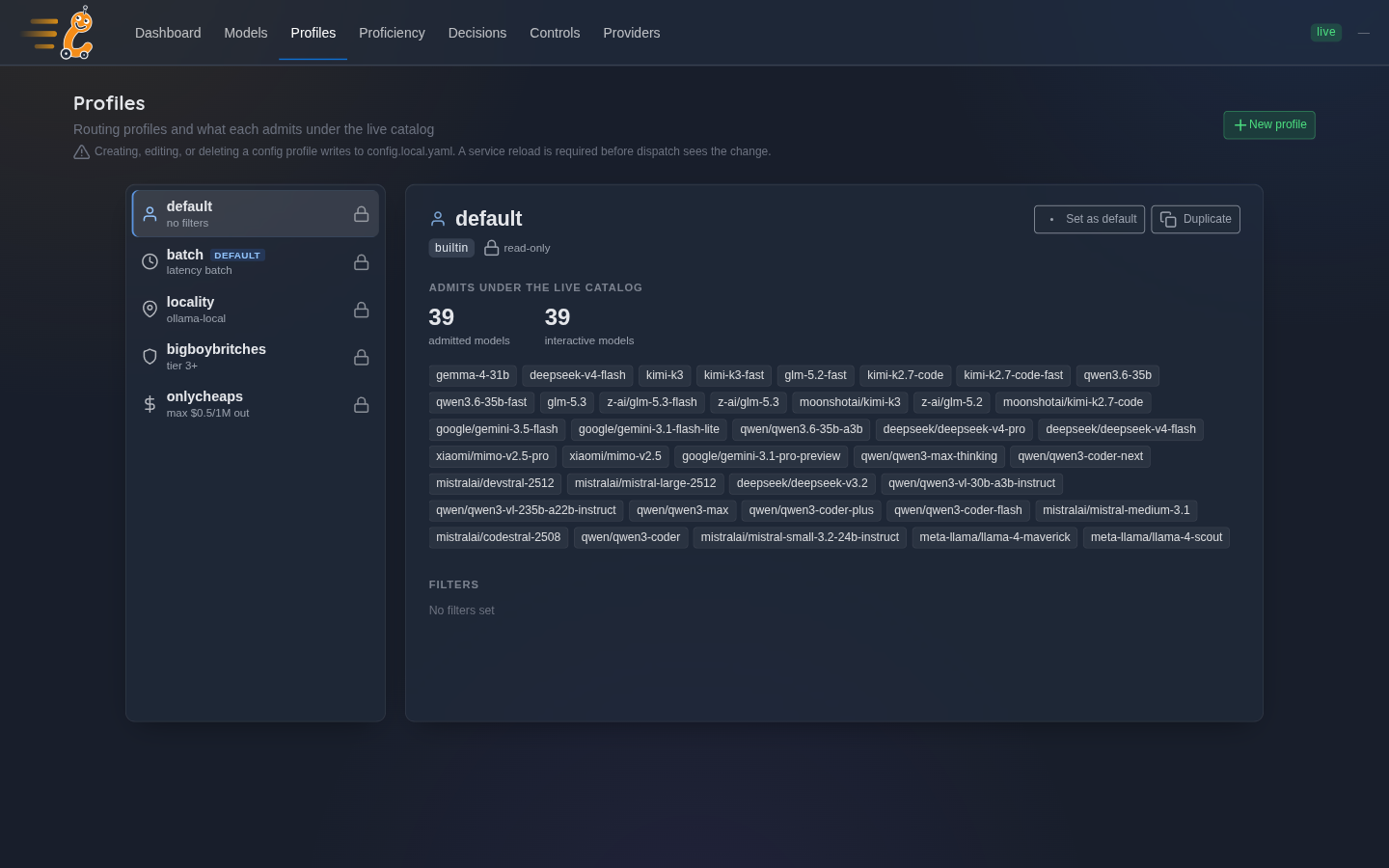
**Profiles** — `GET /admin/profiles` shows each routing profile and what it
admits under the live catalog.
The page uses a **two-pane layout** (not a card grid): a narrow master list on
the left carries one compact line per profile — name, icon, admitted/interactive
counts, default badge, and a category-coverage info icon for access-gated rows.
Clicking a line loads the detail pane on the right, which consumes the full
width. The page header has a **New profile** button (opens the create/edit modal
in `config.local.yaml`).
Built-in profiles are read-only; the detail pane shows a **Duplicate** button
for each — opening a create modal pre-filled from the built-in definition under a
new name, producing an ordinary config profile. Config profiles can be **edited
inline** in the detail pane, **duplicated**, and **deleted** (unless they are the
current `routing.default_profile`, in which case the delete button is disabled).
Admission is probed **per task category**, not once with `task_category=None`.
`eligible_categories` is a restrict-only gate, so a category-gated row is
excluded from a category-less question, and `locality` used to report
"admits 0 models" while its one active `ollama-local` row was serving the two
categories it exists for. A badge that calls a working profile broken teaches
operators to ignore the badge on the day it is real — and the day it is real
is [incident #3](incidents.md). The card now reads *"admits 1 model for 2 of
11 task categories"*, and the zero-admit warning is reserved for a profile
that admits nothing under any category.
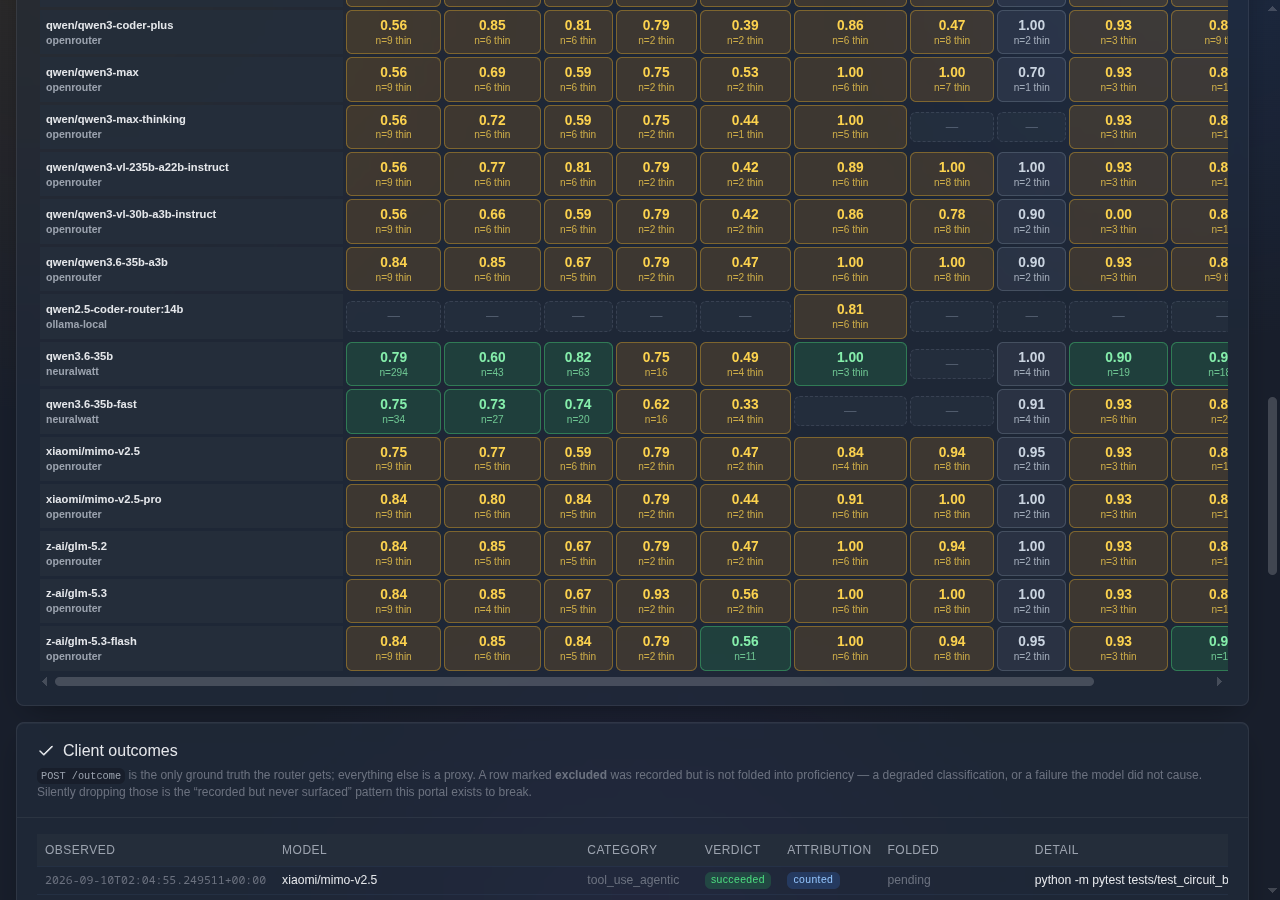
**Proficiency** — `GET /admin/proficiency` is the model × category matrix of
`blended_score`. `proficiency_score` is the only category-dependent term in
the ranking, so this is the table that decides routing; before this page the
portal's entire surface for it was a top-N list for one category on the
dashboard.
The page's one load-bearing requirement is that **a score traffic earned must
not look like one that was copied in**. Colour carries provenance and nothing
else — value is left to the digits, because a heatmap of `blended_score` would
put the eye on the number and hide exactly the distinction the page is for:
| cell | meaning |
|---|---|
| green | measured here, from this row's own client outcomes |
| amber | not measured here — an inherited prior, or a copy |
| blue | benchmark, at or above `proficiency.self_eval_min_samples` |
| slate | benchmark, below that floor (thin) |
| corner wedge | `inherited_from` names the row it was copied from |
**Inheritance outranks `source`**, and that ordering matters: a `-flex` row
carries its family's number verbatim, `source` column included, so rows exist
reading `source='outcome_blended'` with `inherited_from` set. Colouring those
green would paint a copy as a measurement.
Every cell opens a detail popup with `leaderboard_score`, `self_eval_score`,
`outcome_score`, both sample counts, `inherited_from`, and `last_updated`.
Filter by category, source or model name; sort by model, mean score or samples.
The page is **read-only and there is no write endpoint**, deliberately.
Proficiency is derived from evaluation and client outcomes, so a hand-edited
score is a fabricated measurement — the same failure as the empty
`leaderboards.yaml` and the provider's `static_fallback` carbon constant this
project already excludes.
Its lower card lists recent `POST /outcome` reports — the only ground truth
the router gets — with each one's verdict, whether it was **counted or
excluded** (`model_attributable`), and whether `feedback.py` has folded it in
yet. That exclusion needed surfacing: degraded-classification outcomes are
recorded and then silently dropped from folding, and "recorded but never
surfaced" is a pattern this project has now hit four times.
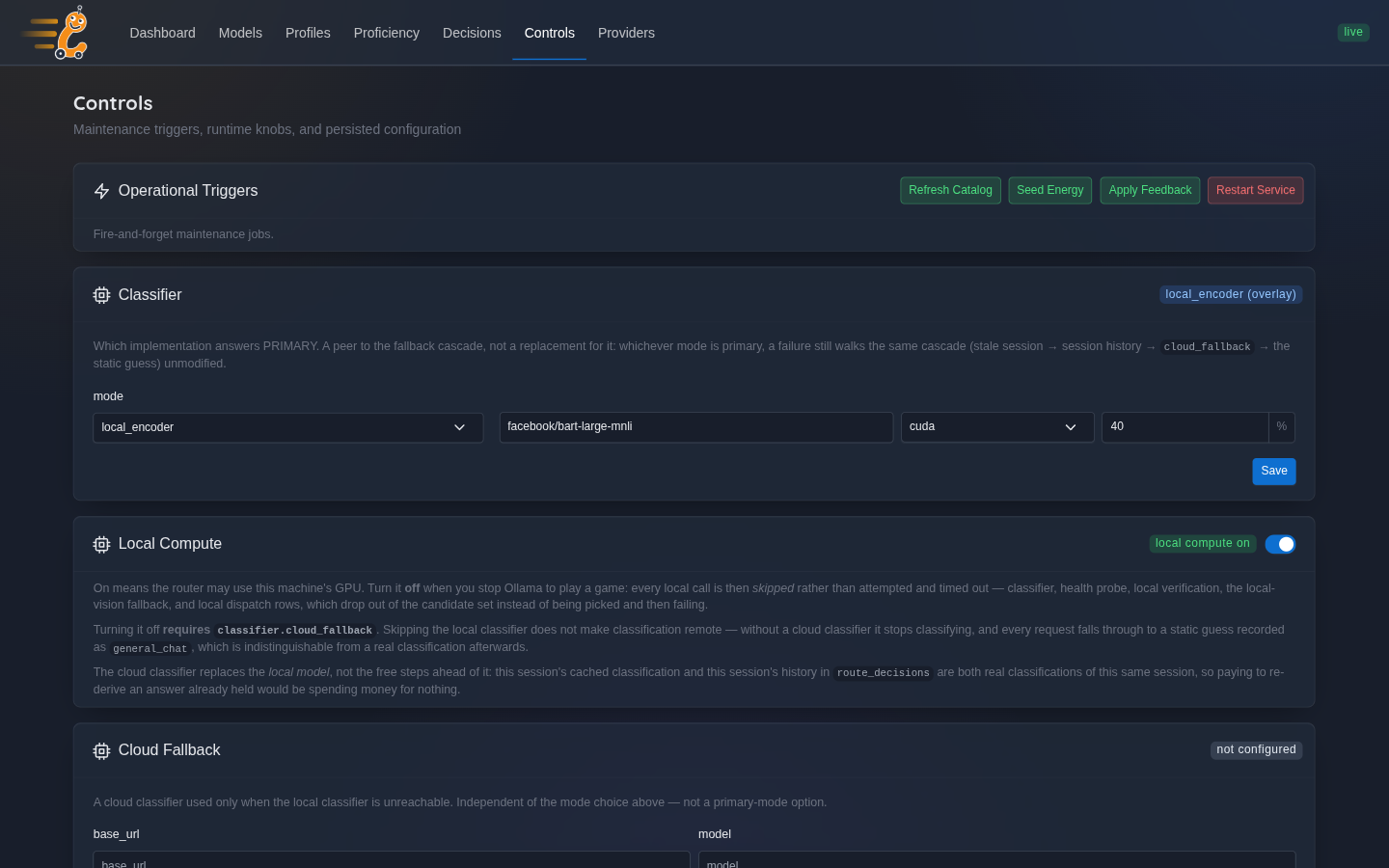
**Controls** — `GET /admin/controls` holds the operational triggers, runtime
knobs, the classifier's mode config, and the persisted config editor (writes
land in `config/config.local.yaml`; see
[config-local-overlay](config-local-overlay.md)). Changes are marked as dirty
and written only on save.
#### Knob organization
The generic knob table is grouped into **six categories**, each with a
collapsible section header:
1. **Routing / Quality / Cost** — the core dispatch objective: logging
levels, energy ceiling, plan quota, cache pricing, and default profile.
2. **Classification** — classifier runtime scalars such as cooldown,
fallback tier/category, degraded warning thresholds, and context framing.
3. **Local Hardware** — gates over local compute paths: the local-compute
master switch, local verification, and local vision fallback.
4. **Caching / Context** — session classification cache and context pruning
(pinch).
5. **Safety Nets** — circuit breaker.
6. **Watchdog** — response-loop detector thresholds.
Within each category, knobs marked **Advanced** hide behind a secondary
"Advanced" accordion. These are shape parameters internal to a covered master
switch (for example, pinch relevance options and watchdog detector
thresholds). The accordion keeps the first view short without removing access.
Knobs reach the page through **three coverage sources**:
- **Registry knobs** — runtime toggles from `_BOOL_KNOBS`, `_FLOAT_KNOBS`, and
`_INT_KNOBS` in `admin.py`. They take effect immediately in memory and
revert on restart.
- **Allowlist knobs** — the same scalars persisted through
`_CONFIG_ALLOWLIST`, written to `config/config.local.yaml` and surviving a
restart.
- **Card-backed paths** — knobs with their own dedicated admin card and
endpoint pair because they have cross-field structure a flat scalar input
cannot safely represent.
It carries three dedicated cards, none a row in the generic runtime-knob
list, because each has cross-field structure a flat scalar/boolean input
can't safely represent:
- **Local Compute** — "gaming mode". See [Gaming mode](#gaming-mode) below.
- **Classifier** — `classifier.mode`'s config (`cloud_llm` needs a pinned
primary or `auto`; `local_encoder` needs a model id; `local_decision` needs a
generative model id). It shows the current mode and, for `cloud_primary_auto`,
the **live** resolved cheapest candidate — computed with
`routing.cheapest_classifier_candidate`, the same function `classify()`
calls, not a static echo of the config. An admin panel that shows a config
value instead of what dispatch actually does is a real class of bug — the same
lesson the profiles zero-admit badge above already taught this project — and a
"live" reading that is secretly stale is worse than no reading at all.
`POST /admin/api/classifier-config` validates the same way config load does:
an invalid combination (e.g. `cloud_llm` with neither a pinned primary nor
`auto`) is rejected before anything reaches `config.local.yaml`, and mode
plus its companion block are written as one atomic change so an in-between
invalid state is never even written transiently.
The header badge names the mode that is **running**, not the one saved. A
save only persists to `config.local.yaml`, and the router reads this block at
startup, so an amber `restart pending` badge sits beside it until the service
restarts. A blank field is left out of the overlay, so the repo default keeps
applying; a typed `0` is saved as `0`.
When `local_decision` is selected the panel reveals a **Local Decision**
block with the fields from `LocalDecisionConfig` in `src/config.py`:
| field | type | default | meaning |
|---|---|---|---|
| `base_url` | string | `http://localhost:11434` | Ollama endpoint for the generative classifier |
| `model` | string | `qwen3.5:4b` | The small generative model that picks category by choice |
| `num_ctx` | int | `8192` | Context window passed to the model |
| `timeout_s` | int | `10` | Seconds before the request times out |
| `confidence_min` | float | `0.5` | Minimum logprob-derived confidence to accept the verdict (range [0.0, 1.0]); below this the classification cascades as a failure |
| `coverage_min` | float | `0.3` | Minimum total probability mass on option letters; below this `parse_logprobs` raises and the classification cascades |
| `tier_enabled` | bool | `false` | Whether the classifier may also decide `task_tier` (vs. only category) |
- **Watchdog** — the watchdog's live state (`controls.html#watchdog-card`,
`loadWatchdog()`): the last tick time (and a `no tick` badge before the
first one), how many sessions the last tick saw, how many verdicts it
flagged, and how many alerts are currently open. Below those, a set of
**notification channel** toggles (each channel with an enable/disable and a
minimum severity, persisted via `POST /admin/api/watchdog/channels`), a
**Refresh** button, and a **Send test alert** button (`POST
/admin/api/watchdog/test-alert`).
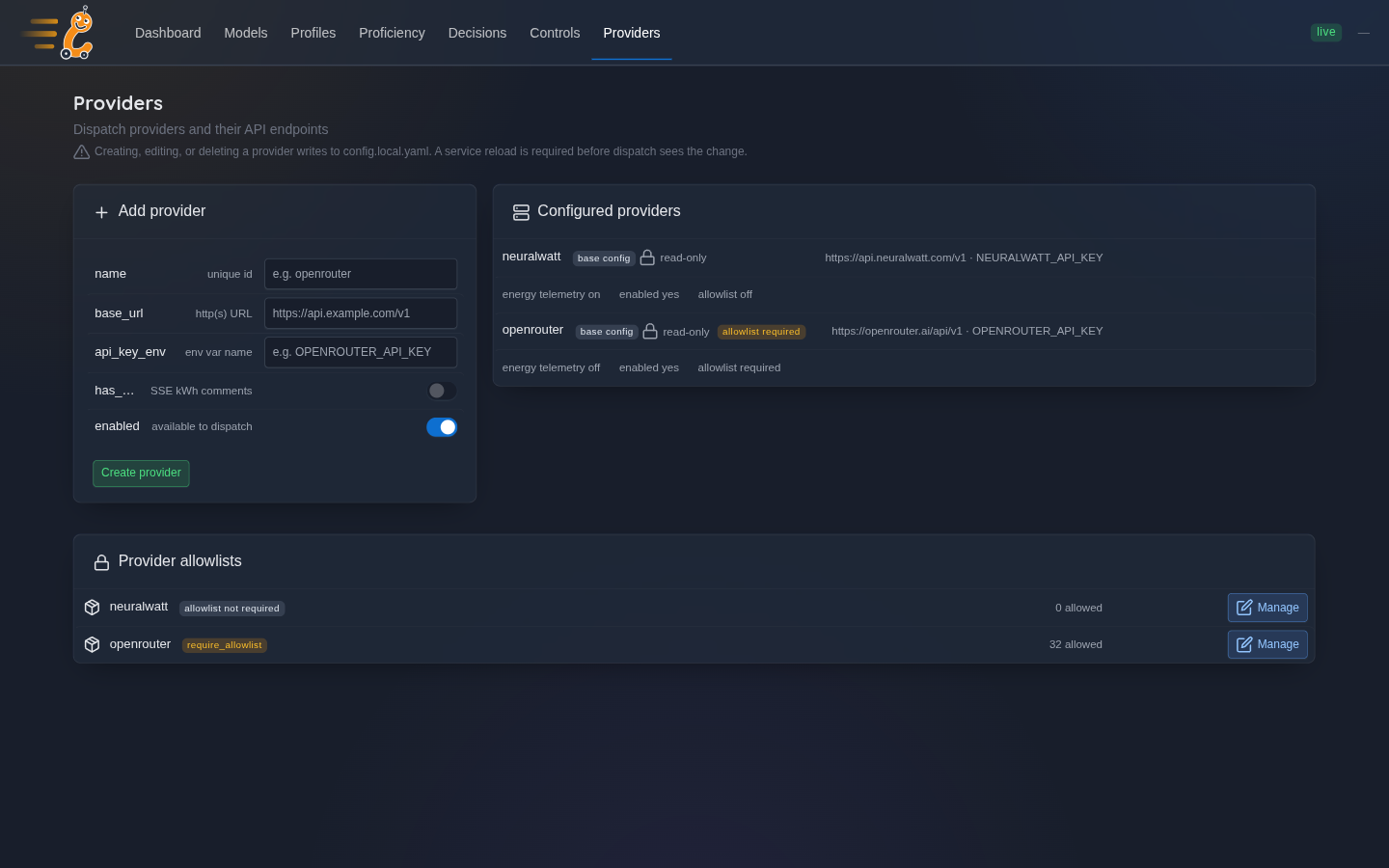
**Providers** — `GET /admin/providers` is the dispatch-provider management page.
The left card adds a new provider (`name`, `base_url`, `api_key_env`,
`has_energy_telemetry`, `enabled`); the right card lists configured providers
with their source badge (base config vs overlay) and edit/delete actions. Base
providers are read-only; overlay providers can be edited or deleted. Creating,
editing, or deleting a provider writes to `config/config.local.yaml`, and a
service reload is required before dispatch sees the change.
Below the provider list is the **Provider allowlists** card. It lists every
provider and whether `require_allowlist` is enabled. For providers with an
allowlist, click **Manage** to see the current allowed model ids, remove
entries, and browse a live upstream catalog preview to add models with an
optional note. The catalog preview calls `poller.fetch_openrouter` directly, so
it is only available for OpenRouter providers that require an allowlist.
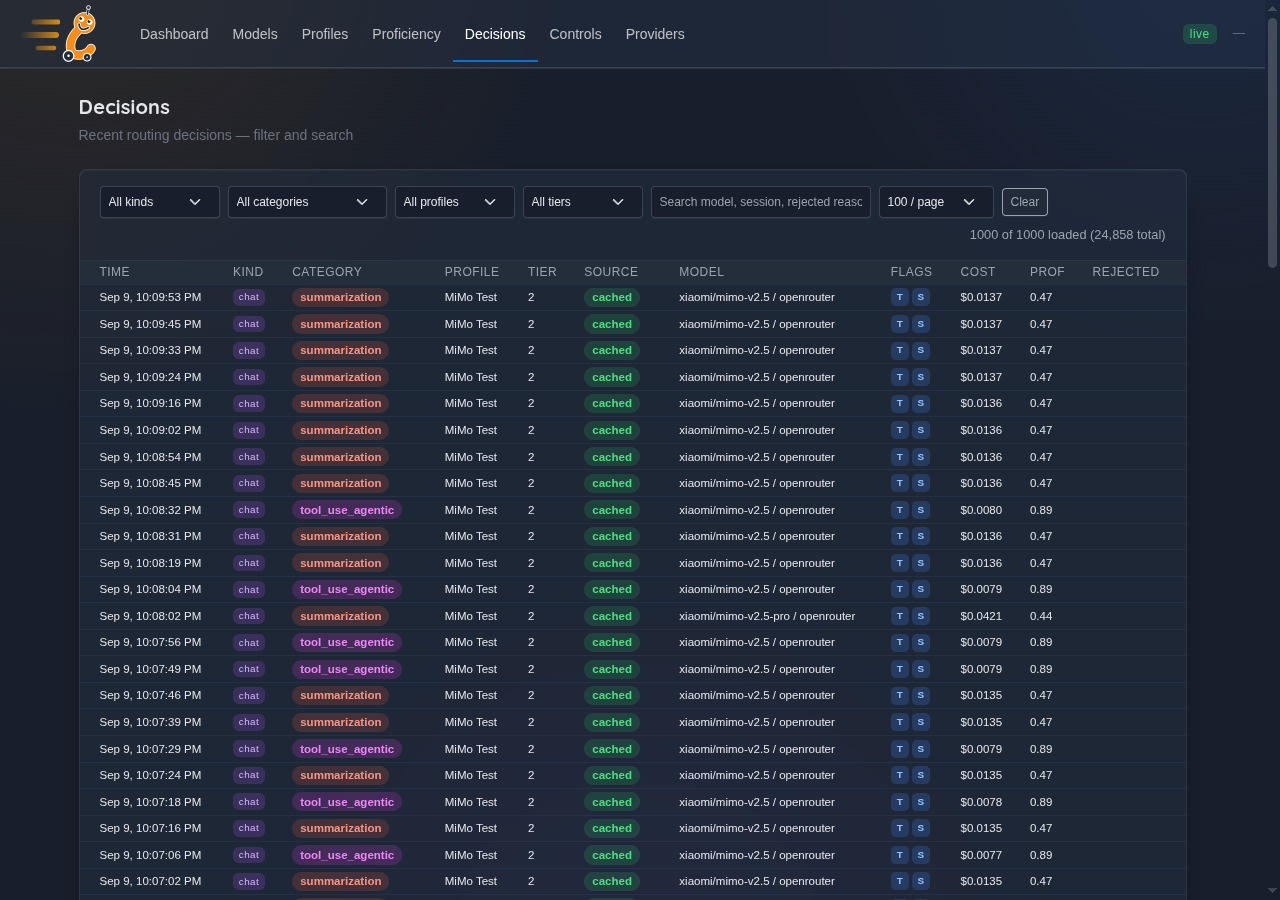
**Decisions** — `GET /admin/decisions` is the full decision log with
kind/category/tier filters and free-text search.
### The stale-page notice
An admin tab left open across a frontend change keeps running the JavaScript it
loaded, and the way that surfaces is unhelpful: the old code posts a field the
shipped code no longer sends, and the operator gets a 422 about a field that is
not in the file in front of them.
**This is not an HTTP caching bug, and no header fixes it.** Every frontend
route in `admin.py` already sets `Cache-Control: no-cache`, and `FileResponse`
supplies `ETag` and `Last-Modified`, so any page *load* revalidates and gets
fresh bytes. Verified against the live service:
```
GET /admin/profiles
cache-control: no-cache
etag: "27f7f7286a7435089bd3e372f447d4a5"
last-modified: Sat, 12 Sep 2026 16:02:48 GMT
```
The tab never loads again, so there is no request to attach a header to. The
page has to ask instead.
`GET /admin/api/frontend-version` returns `{"digest": "..."}` — a SHA-256 over
`(name, st_mtime_ns, st_size)` for every file the frontend routes serve. It
reads no file contents: the question is only whether the files under an open
page moved, and stat()ing them answers it. mtime is in the digest as well as
size because the case this exists for is a hand-edit during iteration, which
frequently does not change a file's length. A missing file contributes a marker
rather than raising.
`admin._FRONTEND_FILES` is the set that gets fingerprinted, and
`tests/test_admin_frontend.py` pins it against the directory listing. A page
added to the portal but not to that list would be invisible to the poll, which
reopens exactly the failure the notice exists to close.
`navbar.js` — one file, loaded by all eight pages — captures the digest on load
and re-checks it every 30s, plus whenever the tab becomes visible again, which
is the moment that matches the failure's shape. A change shows a fixed pill in
the bottom-right corner reading **This page is out of date**, with a **Reload**
button and a dismiss. It is `position: fixed` and hidden until it fires, so it
shifts nothing when it appears, and it is not a slot in the navbar cluster
because appearing there would shove the status dot and the profile switcher
sideways — and the navbar scrolls out of view while the reason to reload does
not. Dismissing hides it until the *next* change.
**It never reloads by itself.** An operator may be mid-edit in a profile modal
or holding a dirty config row, and discarding that silently costs more than the
staleness does. The offer is the feature.
The poll interval is a constant in `navbar.js`, not a config knob. The repo's
"every knob belongs in `config.yaml`" rule is about config the *router* reads;
nothing in the routing path depends on this number, and a key in `config.py`
plus `config.yaml` whose only consumer is a browser timer would be a knob
pretending to be policy.
### Gaming mode
`local_compute.enabled` (default `true`) is the outer gate over every call the
router makes to local hardware. Turn it off when you stop Ollama to give the
GPU back to something else, and the router **skips** the local path instead of
discovering the outage one `classifier.timeout_seconds` at a time — 120s per
request on this deployment — at each call site independently.
Skip, not fail. The gate sits above the client construction at every site:
| call site | behaviour with local compute off |
|---|---|
| classifier | skipped without dialling; goes straight to the cascade |
| `/health` probe | `classifier_reachable: null` — not asked, not unreachable |
| local verification | both the buffered and the streamed path decline |
| local vision fallback | declines |
| local dispatch rows | dropped in `load_candidates`, so a local row is never selected and then 503'd at dispatch |
| `/v1/models` | stops listing local rows; an explicit pin gets a 503 naming the flag |
It is **one flag the code reads, not a macro that writes five keys.** A macro
is hard to undo cleanly, drifts the moment a sixth call site appears, and
leaves nobody able to answer "why isn't the classifier running?" from one
place. `verification.local_llm_enabled`, `local_vision.enabled` and
`local_energy.enabled` keep their own meanings; this ANDs over them, so
turning it back on restores exactly the state you left.
**It refuses to engage without `classifier.cloud_fallback`** — on the runtime
knob (409) and at config load (a validation error). Skipping the local
classifier does not make classification remote; without a cloud classifier it
stops classifying, and every request falls through to a static guess recorded
as `general_chat`, a fully scored category that is indistinguishable from a
real classification afterwards. A refusal rather than a warning, because a
warning is what nobody reads while their game is loading. Nothing auto-writes
the `cloud_fallback` block — uncommenting the shipped example in
`config/config.yaml` is the intended setup path.
With the mode on, cascade steps 1 and 2 still run **ahead** of the cloud call.
A stale session classification is free and was a real classification of that
same session, so paying to re-derive an answer already held would be spending
money for nothing. "Force cloud" replaces the local *model*, not free correct
answers. Cloud classifications carry `source="classifier_cloud"`, which is in
the attributable set, so `POST /outcome` keeps training proficiency normally.
**Read-only dashboards** — `GET /admin/api/snapshot` exposes data for:
- `quota` — per-provider billing shape from `quota_accounts()`: `period` (billing window with start/next_reset/elapsed_fraction/source), `accounts[]` (list of per-provider dicts with `provider`, `shape`: `metered_plan | prepaid_credit | self_hosted | unmetered`, `spend_usd`, and type-specific blocks: `plan` for metered_plan, `pool` for prepaid_credit, `burn` for burn-rate metrics, `credit` when a balance URL was polled, `energy` for kWh/calls), `spend` (aggregate spend with `by_provider_usd`, `total_usd`, `estimated_usd`, and `estimate_ratio`), and `alarm` (plan-pace or stale-reading alert with kind/severity/headline). The old `by_provider` / `total_balance_usd` shape was removed.
- per-model usage from `energy_observations`
- live routing decisions from `route_decisions`
- verdict mix and scoring coverage
- history: `GET /admin/api/history?range=6h` (also `1h`, `24h`, `7d`, `30d`)
`GET /admin/api/proficiency` serves the proficiency matrix (every row with
`source`, both sample counts, `inherited_from`, `last_updated`, and a
server-computed `thin` flag) plus the recent client outcomes. Both queries live
in `metrics.py`, which must never import `dispatcher` — that separation is what
keeps them usable from `/health`, the TUI and the portal without a circular
import. There is no write counterpart.
`GET /admin/api/frontend-version` returns the frontend fingerprint that backs
the stale-page notice above. It stats the served files and reads none of them.
**Operational triggers** — async, fire-and-forget maintenance jobs:
- `POST /admin/api/refresh-catalog` runs the poller and tier pass
- `POST /admin/api/seed-energy?samples=N` starts a reference sweep
- `POST /admin/api/apply-feedback?dry_run=true` runs `feedback.py`
- `POST /admin/api/restart-service` restarts the running systemd unit
**Runtime toggles**
`GET /admin/api/runtime` shows persisted-vs-runtime values. `POST /admin/api/runtime/{knob}`
flips in-memory settings such as `log_route_decisions`, `local_llm_enabled`
and `local_compute_enabled`. Changes take effect immediately but reset on
restart. One knob can be refused rather than applied: see
[Gaming mode](#gaming-mode).
Most knobs are booleans (`_BOOL_KNOBS` in `admin.py`) and
`default_flex_preference` / `active_profile` are strings. Numbers get one table
per type, not one shared table:
| table | knob | range | blank |
|---|---|---|---|
| `_FLOAT_KNOBS` | `incumbent_challenger_cache_rate` | 0 - 1 | neutral |
| `_INT_KNOBS` | `session_cache_staleness_seconds` | 5 - 7200 | refused |
They are separate because the declared type has to survive the write.
`_FLOAT_KNOBS` coerces with `float(value)`, and `session_cache.staleness_seconds`
is declared `int` — a float there would leave the running `cfg` holding a value
`load_config` could never produce, and a fractional one would 422 the persisted
twin at load. The float tuple also carries a fourth element, `neutral_path`,
which exists only because the dial has a null-means-neutral semantic; an int
knob with no neutral would need a sentinel in it.
A runtime write bypasses every Pydantic validator — `StrictModel` sets
`extra="forbid"`, not `validate_assignment` — so the endpoint does the type and
range checking itself: a numeric knob refuses anything that is not a number
(booleans included, since `True` is an `int` in Python and would land as `1.0`
or a 1-second window) and anything outside its declared bounds. `_INT_KNOBS`
also refuses floats rather than truncating them, and imports its bounds from
`config.STALENESS_SECONDS_MIN`/`MAX` so the runtime path and the config
validator cannot drift into disagreeing about what the service will boot with.
**Persisted config edits**
`GET /admin/api/config` lists allowlisted keys. `POST /admin/api/config/{key}`
writes one allowlisted key back to `config/config.local.yaml` with a timestamped
backup and whole-config validation of the merged base + overlay. Arbitrary keys
are rejected.
**Incumbent cache pricing (Wave 2)**
Both knobs appear in *both* panels, as two adjacent rows:
| key | runtime knob | persisted key |
|---|---|---|
| gate | `incumbent_cache_pricing` | `objective.incumbent_cache_pricing` |
| challenger dial | `incumbent_challenger_cache_rate` | `objective.incumbent_challenger_cache_rate` |
The runtime pair is the one that matters for tuning. The dial exists so the
feature can be walked from neutral to full penalty **without a revert**, with a
re-measurement between each step (see `docs/routing.md` § incumbency pricing);
a loop that needs a tracked-file edit and a `systemctl --user restart` between
readings is a loop nobody walks. `dispatcher.py` reads `cfg.objective.*` per
request, so an in-memory write is live on the next one.
**Blank means neutral, never zero.** They are opposite ends of the same dial:
`null` follows `objective.assumed_cache_rate`, so a challenger pays nothing for
discarding the incumbent's cache, while `0.0` prices every challenger as a
fully cold prompt — the maximum incumbent advantage. So an empty field posts
`null`, not `0` (`Number('')` is `0` in JavaScript, which is exactly how an
operator clearing the field to switch the feature off would instead have
switched it to maximum). The persisted path writes `null` through to the
overlay and lets `Objective._resolve_challenger_cache_rate` resolve it at load;
the runtime path makes the same substitution itself, so `cfg` only ever holds
one representation of neutral. Both directions are pinned by tests in
`tests/test_admin_config.py` and `tests/test_admin_runtime.py`.
The dial is a cache **rate in [0, 1]**, not a percentage, and the UI does no
scaling — what is typed is what is stored. That is the
`classifier.confidence_threshold` lesson applied rather than relearned: that
control saved a raw `80` meaning 80% for a field the loader wanted as
`0.0`-`1.0`, and it was caught before the restart only by luck. Out-of-range
values are refused by the endpoint on the runtime path and by `RouterConfig`
validation of the merged config on the persisted path, before any byte reaches
disk.
Neither knob is enabled in tracked config: `incumbent_cache_pricing` ships
`false` and the dial ships blank.
**Session classification cache**
The same shape as the pair above — a switch and the window it gates, adjacent
in both panels:
| key | runtime knob | persisted key |
|---|---|---|
| switch | `session_cache_enabled` | `session_cache.enabled` |
| window | `session_cache_staleness_seconds` | `session_cache.staleness_seconds` |
The window decides how long **one** classification keeps steering routing, so
it is the knob that sets the size of the concession CLAUDE.md's north star rule
2 describes, not an implementation detail of the switch. Measured on live
traffic: 96.6% of all classifications are cache replays, and one classification
drove 107 consecutive turns across 840s. Before this control the only
available settings were a 1200-second window or no cache at all, and the answer
is almost certainly in between — which is why the runtime half matters.
`dispatcher.py` reads `cfg.session_cache.staleness_seconds` per request, so a
narrower window is live on the next one and the replay share can be re-measured
without a restart.
**Units are seconds and the UI does no scaling** — what is typed is what is
stored, the `classifier.confidence_threshold` lesson applied rather than
relearned. The field is an `int`, and a float is refused rather than truncated:
`20.5` quietly becoming `20` is a window nobody chose.
**Blank is refused, and so is 0.** They are not the same as switching the cache
off, and the difference is easy to miss:
- `session_cache.put` still writes on every turn, so the entry exists.
- The classifier-failure cascade reads it with `session_cache.stale_read`,
which **ignores staleness entirely** — so a 0-second window still replays a
session's label whenever the classifier is down.
So 0 is out of range (floor 5, the pre-existing `> 0` rule) and an empty field
posts `null`, which the runtime endpoint refuses with a message naming
`session_cache_enabled` as the switch the operator was reaching for. The
persisted path refuses both through whole-config validation of the merged
base + overlay, before any byte reaches disk.
The ceiling, 7200, is a judgement: an unbounded window is a cache that never
expires. It is 7200/1200 = 6x (same ratio) the shipped default and 7200/840 ≈
8.57x the longest single-classification
run measured, so it sits above every value there is a reason to try while still
guaranteeing a label cannot outlive the working session that produced it. The
bound lives in `config.py` (`STALENESS_SECONDS_MIN`/`MAX`) so a file edit, an
overlay write and a runtime POST all enforce the same range.
The shipped default is unchanged: `enabled: true`, `staleness_seconds: 1200`.
**Classifier mode**
`GET /admin/api/classifier-config` / `POST /admin/api/classifier-config` are
a separate pair from the allowlist above, deliberately: `classifier.mode`
plus its companion block (`cloud_primary`/`cloud_primary_auto` or `encoder`)
is not one scalar, so it needs both fields written together or an
intermediate invalid state could land on disk. The GET response includes
`resolved_primary` — the live result of
`routing.cheapest_classifier_candidate` against the current catalog when
`cloud_primary_auto` is set, `null` otherwise.
`mode` in that response is the **saved** value. `running_mode` is what the
process is using, and `restart_pending` is `true` when the saved classifier
block differs from the running one in any field, or `null` when the saved
config no longer validates and the comparison cannot be made. The block is read
at import, so only a restart closes the gap.
**Model availability overrides**
`POST /admin/api/models/{model_id:path}/{provider}/availability` marks a model
as `active`, `blocked`, `deprecated`, or `stale`. `DELETE` on the same path
removes the override. The `{model_id:path}` converter accepts model ids that
contain slashes, so providers like OpenRouter with slash-bearing ids are
handled the same way as plain ids. Deprecation feeds into the routing hard
filters.
**Not built yet.** The Loops panel does not yet show the evidence columns an
operator would act on — agent, model, top repeated target, calls, and $ since
the last landed change — and there is no per-model stall rollup, no **Block
model** button beside the evidence, and no Blocked list with reasons. Those are
the remaining surface of [North Star #4](../CLAUDE.md) in CLAUDE.md, whose first
half (conversation identity and the watchdog) is shipped.